


Press Release Details




From Deserts to Saline Lands: Smart Solar Tracking Solutions for Harsh Environments
With the global energy transition accelerating, solar PV has seen a remarkable surge in global capacity in recent years. As the sector expands, PV projects are increasingly diversifying beyond traditional flat and unobstructed sites, extending to more challenging landscapes such as wastelands, farmlands, water surfaces, and complex terrains like hills and mountains. However, these environments also introduce significant obstacles to both deployment and operational efficiency.
To address this, Clenergy provides a professional and reliable solution. Our smart solar tracking systems can adapt flexibly to diverse terrains while maximising solar energy capture, ensuring higher returns for investors.
Pain Points of Traditional Systems
Traditional systems usually come with inherent problems that can drive up project costs, reduce operational efficiency, and pose challenges in complex environments.
1. Poor Adaptability to Complex Terrains
Unlike flat terrains, complex landscapes like undulating hills and rocky wastelands demand dynamic adjustments for slope variations and natural obstacles. The rigid design of conventional trackers lacks this flexibility, leading to misaligned components, increased mechanical stress, and long-term reliability issues. This compromises power generation and safety, severely limiting their deployment in geographically diverse solar regions.
2. Cumbersome Installation and High Labour Costs
Traditional PV tracking systems often feature complex mechanical assemblies with numerous bolts, connectors, and intricate drive mechanisms. This structural complexity demands significant on-site assembly and precise calibration, raising labour costs during project execution.
Moreover, these systems typically impose strict compatibility requirements for PV module dimensions and specifications, further restricting design flexibility and customisation potential.
3. Lack of Smart O&M
Traditional trackers often have a shortage of smart operation and maintenance (O&M) capabilities. Insufficient fault diagnosis and early warning features make it difficult for maintenance teams to quickly pinpoint issues. Furthermore, without remote monitoring and automated adjustment functions, these systems require considerable manual intervention, which lowers O&M efficiency.
4. Inadequate Wind Protection Strategy
Wind poses one of the most crucial natural threats to solar power plants. Most systems rely on a simplistic, threshold-based wind protection strategy. In regions with frequent wind speed fluctuations, this can lead to excessive tracker stowing, which markedly reduces effective power generation time. Furthermore, the long-row designs are prone to generating substantial torque and vibration under lateral winds, potentially causing structural fatigue or even damage.
5. Insignificant Power Generation Gains
Due to mechanical transmission errors, imprecise control algorithms, and sensor drift issues, traditional tracking systems often fail to maintain precise solar alignment, resulting in “tracking losses” that directly diminish power generation gains. This problem is particularly pronounced in complex terrains where obstructions like hills, trees, or adjacent trackers may cast shadows on the system during certain periods.
Customized Solutions with Clenergy Smart Solar Tracking Systems
As a leading solar tracker manufacturer, Clenergy offers advanced PV tracking systems tailored to overcome specific environmental challenges.
1. Smart Solar Tracking Systems for Desert and Arid Regions
(1) Challenge
Sandstorm Erosion: Sandstorms can erode critical mechanical components (e.g., bearings and gears), which may degrade precision, lead to rough operation, or even trigger complete jamming. Furthermore, dust deposited on the surface of photovoltaic panels can severely lower power generation efficiency.
Extreme Climate: Intense daily temperature variations in desert climates can compromise the structural integrity of materials and the reliability of electronic components.
Unstable Terrain and Quicksand: Desert landscapes often exhibit loose, shifting sands and quicksand patches that threaten the stability of mounting structures, thereby prompting tilting or collapse.
Communication Interference: Sandstorms disrupt radio and optical signals, causing communication blackouts that hinder remote monitoring, diagnostics, and control.
(2) Clenergy’s Solution:
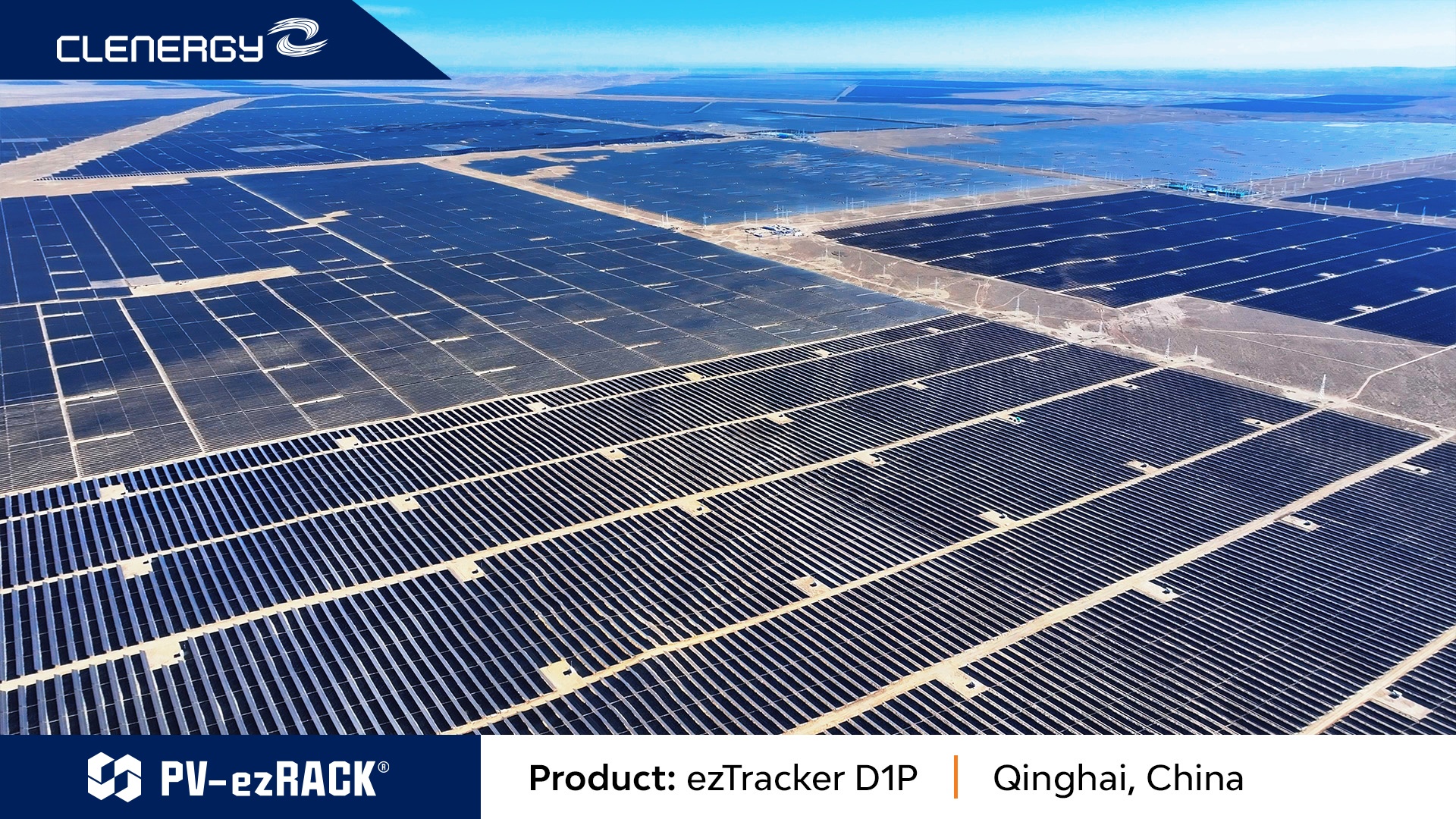
In the past, our ezTracker series was successfully deployed in Qinghai Province on the Qinghai-Tibet Plateau—an area renowned for its high altitude, drastic daily temperature fluctuations, frequent strong winds, and sandstorms—demonstrating outstanding performance under harsh conditions. To further address the extreme challenges of desert environments, we have introduced the upgraded ezTracker D1P120 smart solar tracking system, purpose-built for reliable operation in such demanding settings.
Weather Resistance and Sand-shedding Design: Our D1P 120 smart solar tracking system employs high-hardness, ultra-wear-resistant, eco-friendly zinc-aluminium-magnesium steel, which is twice as hard as conventional steel. Combined with a patented sand-proof design and enhanced bearing durability, it can effectively withstand sandstorm erosion.
Stabilised Foundation Design: With a strengthened structural topology and reduced-pile layout, the smart solar tracking system ensures excellent stability on shifting or volatile ground, while also simplifying installation and minimizing construction costs.
Optimised Wind Load Mitigation: To assure safety and stability under the plateau’s frequent strong winds, our ezTrackerD1P120 utilizes an optimised wind load reduction algorithm, dynamically adjusting the tracker’s position to mitigate wind forces, guaranteeing secure and stable operation even during extreme wind speeds.
Watch the video to learn more
2. Smart Solar Tracking Systems for Corrosive and Coastal Environments
Based on an advanced tracking algorithm, the ezTrackerD1P single-axis solar tracker achieves precise tracking, boosting energy output by up to 25%. Its core structure is made of corrosion-resistant carbon steel, ensuring long-term stable performance in harsh environments characterized by high heat, high humidity, and high salinity.
The multi-point support design enhances overall structural stability, making it better suited for complex terrains. With strong slope adaptability, it can handle inclinations of up to 20%, which greatly expands the potential site selection for solar plants.
Now, the ezTracker D1P solar tracking system has been widely deployed in dozens of large-scale ground-mounted solar power plants across China, Southeast Asia, Europe, and other regions. Notable projects include the saline-alkali land in Weifang, Shandong, and the 77MW ground-mounted solar plant in Kampong Chhnang Province, Cambodia, where it has earned client recognition and strong support.

Conclusion
As worldwide priorities shift toward ecologically sound and optimally effective energy solutions, we invite you to explore how Clenergy smart solar tracking systems can transform your solar projects. Whether you are planning a large-scale utility project in a desert, integrating solar with agriculture and fisheries, or seeking to achieve excellent performance in a saline-alkali environment, our expert team is ready to present tailored solutions meeting your project’s distinct demands.

About Clenergy
Established in Melbourne, Australia, and extending our presence with offices and factories across China, Japan, the Philippines, Thailand, and Germany, Clenergy stands as an enabler for the public sector, enterprises, and governments in pursuit of sustainability and carbon neutrality solutions. Our commitment is grounded in a vision of a future powered by sustainable, clean energy. We persistently reinvent our approach, leveraging innovative technology and service, as we strive towards realising this mission.